How to set your deficit
After losing over 16 kg in a six-month deficit, it sometimes scares me to see how people who want to lose weight start out exactly the way I did. They're serious. They want results quick. They're thinking about deficits of 1,000 to 1,500 calories a day — which for many people is close to half of what they actually burn. And I understand, because I was the same: I had finally made the decision to lose the weight, for real this time, and at that moment your ambition and discipline are at their absolute maximum, so why not use them?
But I'm here to tell you there's a better way. There must be a better way, because that approach is almost certain to fail.
Here's the reframe that helped me: a deficit isn't just a number you subtract — it's a budget cut, and like any budget cut, what matters is not only how much you cut but what still gets funded. Your body has bills to pay. Cut into the wrong ones and it doesn't send a polite invoice — it pushes back: hunger, fatigue, lost muscle, and a metabolism that quietly turns the thermostat down.
So instead of starting from "how fast can I lose," start from the other end: what does your body need even while dieting? Stack those needs up, and the right deficit is whatever room is left — not whatever ambition demands.
The five layers your deficit must not cut into
Think of it as five layers, from the most physiological to the most human.
1. Micronutrients — the non-negotiable floor
Vitamins, minerals, fiber, essential fats. Your body doesn't need fewer of these because you're dieting — arguably it needs them more, since there's less food volume to carry them in. This is why aggressive diets built on tiny portions of the same three foods feel terrible so fast: the calories dropped, but so did everything riding along with them. Practical rule: as calories go down, food quality has to go up. Mostly whole foods, plenty of plants — not because it's virtuous, but because it's the only way to fit the micros into a smaller budget.
2. Macronutrients — protect the machine
In a deficit, your body burns tissue for the missing energy. Your job is to make sure that tissue is fat — and that's a game you play with all three macros, not just the famous one.
Protein gets the hype these days, and rightfully so: it's what keeps the weight you lose from including your muscle — the very machinery that burns calories and that you presumably want to keep seeing in the mirror. It's also the most satiating macro, which makes the whole deficit easier to live with. Fund it generously. But protein isn't the whole story.
Fat is the most costly macronutrient — at nine calories per gram it eats your budget faster than anything else — but it's not one you want to find yourself short of. Hormones, cell membranes, absorbing those fat-soluble vitamins from layer 1: all fat-dependent. Cut it to near-zero to "afford" more food volume and you'll pay in exactly the systems a dieter can least spare.
Carbs get dismissed as "just energy" — but in a deficit, energy for training is precisely what's scarce. Carbs are what keep you able to exercise and perform at your usual level; strip them too far and your sessions go flat, and with them the training stimulus that tells your body to keep its muscle.
Play your macros right and the muscle or performance loss people fear is truly minimal — and if you're newer to training, your "newbie gains" might even offset it completely for the first few months. It happened to me: growing muscle and setting new PRs, months into a deficit.
3. The energy floor — don't cut into the bone
Below the macros sits raw energy itself. There is a level of intake under which your body stops cooperating: training quality collapses, sleep degrades, concentration slips, and — as covered in What is TDEE? — adaptive thermogenesis kicks in harder: NEAT dials down, the thermic effect of your (now smaller) meals shrinks, and your BMR eases lower. The cruel arithmetic: the bigger the cut, the harder your body cuts back, so the effective deficit is smaller than the one on paper. You planned a sprint and got a headwind.
4. The no-stress signal — keep the alarm off
This layer is easy to miss because it isn't a nutrient at all. A deficit is a stressor, and your body is a complex machine that constantly monitors its hormones, its energy availability, its stress load — and adjusts everything downstream accordingly. A moderate deficit reads as "food is a bit scarce, we'll adapt calmly." A severe one reads as an emergency — and an organism in emergency mode conserves, downshifts, and fights you: hunger hormones climb, recovery suffers, and the adaptation from layer 3 accelerates. The goal is a deficit small enough that your body never quite raises the alarm. You're trying to lose fat without your body noticing enough to panic.
5. Adherence — the layer for the person, not the body
The four layers above are about your body. The last one is about you — and it's the one that decides whether any of this happens at all. The best deficit on paper is worth nothing if you can't live inside it for months: through birthdays, deadlines, bad weeks, and dinner with friends. A deficit needs slack for a life. If the plan only works when life doesn't happen, it doesn't work. Whatever room the first four layers leave you, spend some of it on sustainability — a slightly smaller deficit you'll actually hold beats a bigger one you'll abandon.
Slow is smooth, smooth is fast
The Navy SEALs have a saying: slow is smooth, and smooth is fast. It's about exactly this trade. The aggressive deficit looks fast, but it triggers the layer-3 and layer-4 pushback, erodes muscle, and burns through the adherence budget — so it delivers less than it promises and usually ends early, often with a rebound that hands the weight back.
I can tell you from experience: six months of easy dieting truly beats two months of suffering — being cold and lethargic, fighting hunger all day, your mind circling around binging and cheating and the next time you're "allowed to go crazy." My smaller deficit made it feel like I almost wasn't dieting at all. Once the patterns settled in, the food noise just… stopped. That's not weakness of ambition — that's the whole strategy. The modest deficit keeps every layer funded, keeps your body calm, and keeps you in the game, week after week, which is the only place results actually accumulate. Over six months, the tortoise isn't just less miserable. The tortoise is ahead.
Keep your eye on the prize
One more trap, and it's a subtle one because it sounds like ambition: trying to win everything at once.
There's a lot of talk about "recomp" — losing the fat and gaining the size and performance at the same time. And to be fair: if you play your macros right, keep the deficit modest, and give it time, some of that can genuinely happen (see those newbie gains above). But it's not a guarantee, and you have to be honest with yourself. If you have to choose — choose. You're better off going for the lower body-fat first and the bigger muscles after. If they happen together, wonderful — but treat that as a by-product, not the plan.
Too many people lose their way believing they'll be the one to do it all at once, and end up doing nothing at all. They make it overly complex; they want to have their cake and eat it too (yes, I see the irony of that line in a diet guide). You see the same failure in companies whose management won't commit to a real strategy because they want every option open. The biggest choice you can make is to make a real choice: commit, don't stop until you're satisfied — and then make the next choice.
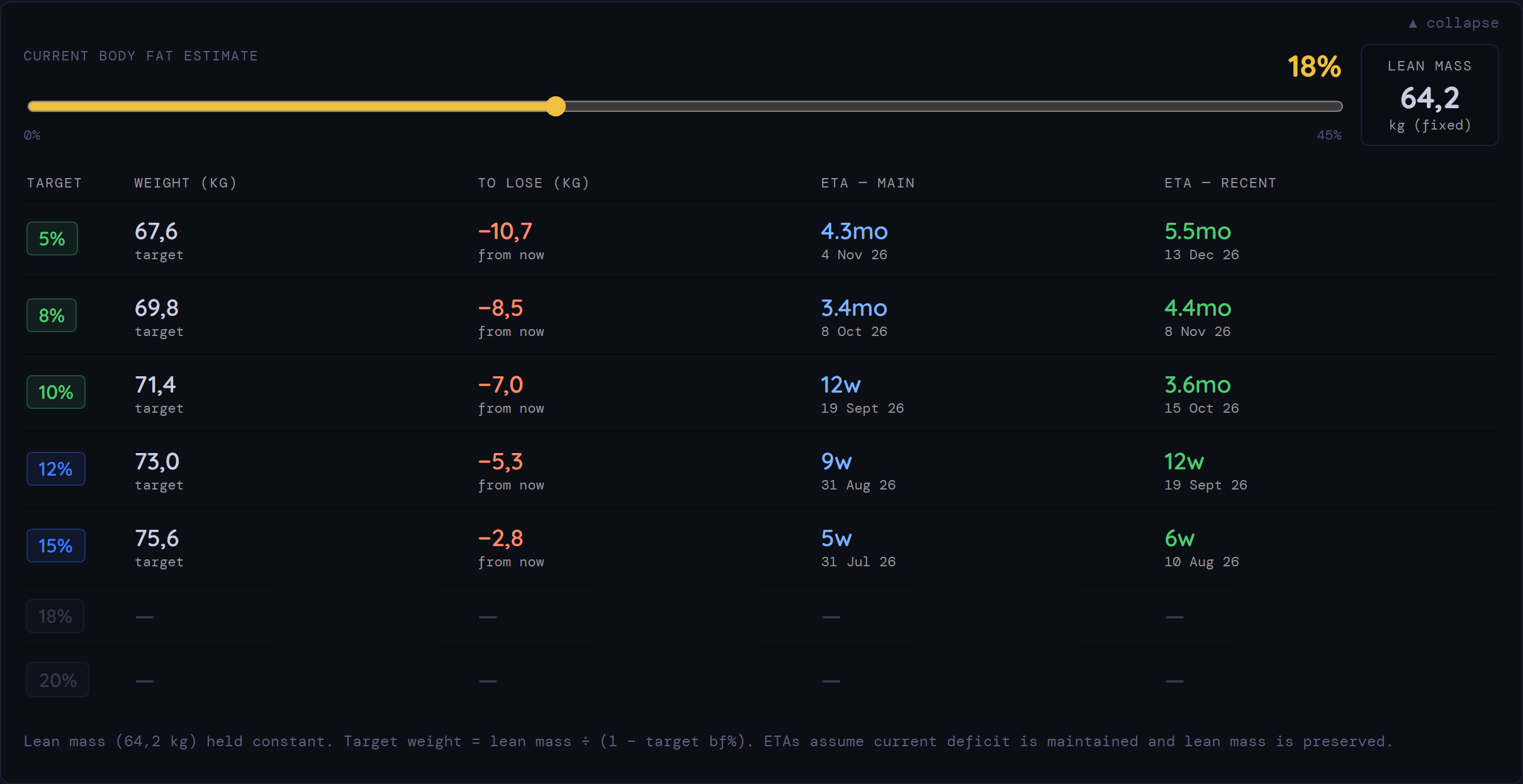
A deficit you can hold has an end you can see: what's left to lose and when you'll get there, projected from the pace you're actually achieving — not the one you planned.
So what's the number?
After all five layers, the honest answer is blanket advice: a modest, sustainable deficit — for most people somewhere around 10–20% below maintenance. Yes, there are people for whom an aggressive cut makes sense — but they know exactly what they're doing, and they don't need this guide. For everyone else: modest. But the deeper answer is that the starting number matters less than you think, because you shouldn't be steering by the plan — you should be steering by the result:
- Your real maintenance is measured from your own data, not a calculator guess — so the baseline you subtract from is true.
- Your weight trend over weeks tells you the deficit you're actually running — which, thanks to adaptation, drifts from the one you planned.
- When the trend says the gap has narrowed, you adjust — calmly, from evidence, instead of slashing further on faith.
Set it modest, watch the pattern, correct as you go. That's the whole method — it's the one that took me 16 kg down without the suffering, and it's the one that keeps working after the finish line, too.
Metabolistic closes that loop for you: it measures your real maintenance from your own logs, shows the deficit you're actually achieving week by week, and lets you watch adaptation happen instead of being ambushed by it.