How to find your real TDEE from your own data
People talk about "calories in, calories out" — then track the in to the gram and take the out from a generic calculator that knows almost nothing about them. This guide is about fixing that asymmetry: measuring your real TDEE (total daily energy expenditure — your maintenance calories) from data you probably already collect.
The principle: energy balance runs backwards too
Everyone knows the forward version: eat below your burn, lose weight. But it works just as well in reverse — if you know what you ate and what your weight did, you can work out what you burned.
Say you averaged 2,200 calories a day for six weeks, and your weight trended down by about a third of a kilo per week. That lost tissue represents energy your body spent but didn't get from food. Add it up, and your true maintenance reveals itself — not "for someone your height and age," but for you, with your genetics, your job, your fidgeting, your workouts, your life. Every calculator input that was a guess is simply real here, because it happened.
What you need
- A daily weight. Same scale, roughly the same time (mornings work best). Don't fear the fluctuations — they're water and timing, and they average out. Missing a day here and there is fine.
- A daily calorie log. As honest as you can make it. Consistency matters more than perfection — a consistent small bias barely affects the result.
- A bit of time. A single day tells you nothing — you don't know how much you fidgeted, slept or moved. But you don't need to wait months to start: even a few weeks gives a usable estimate, and it simply becomes more accurate the longer you log, as more of your ups and downs average into your true underlying pattern. Start with what you have; it will improve from there.
Why the smoothing matters
Raw daily weights zigzag — water, salt, timing. If you computed your burn from any two days, you'd get nonsense. The method only works on the trend: the smoothed line underneath the noise. That's what separates a real measurement from scale-anxiety: one bad morning is invisible to the trend, and so it should be invisible to your decisions.
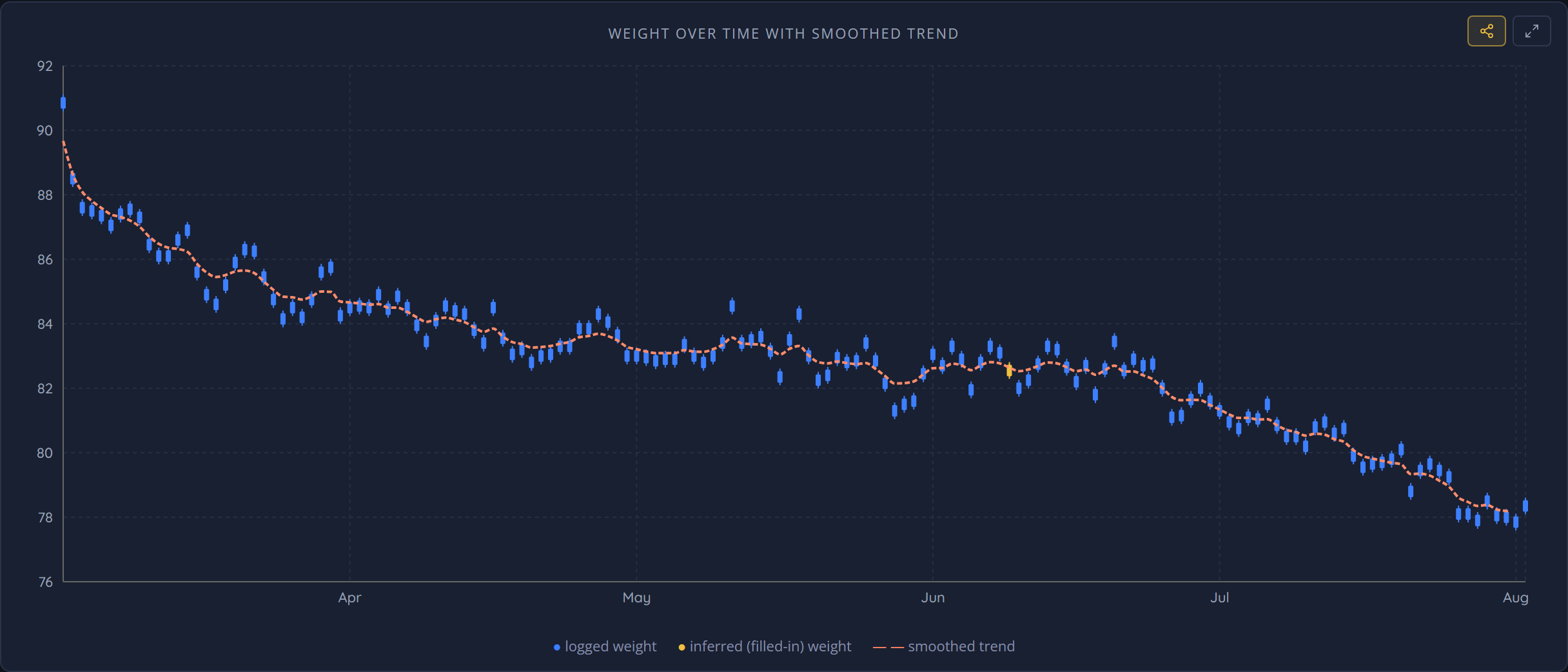
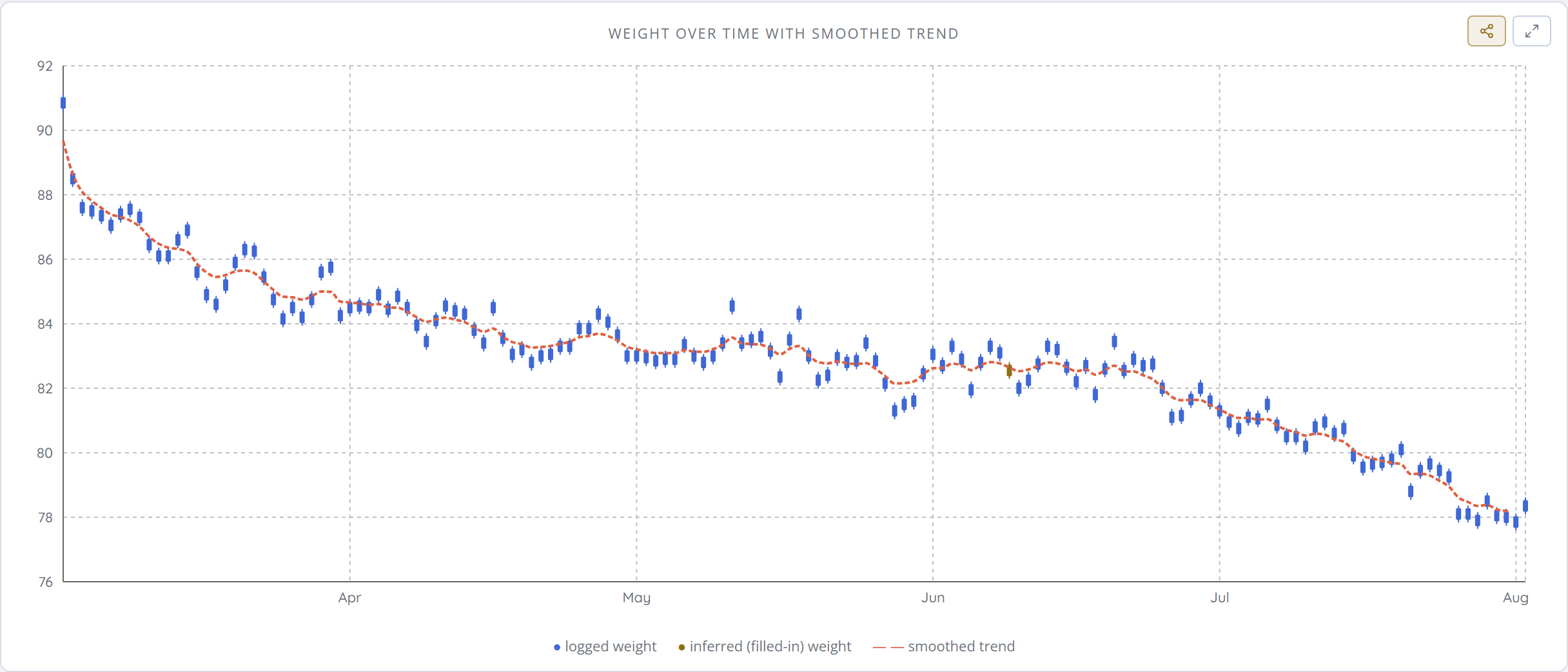
The method, running: every logged weigh-in, and the smoothed trend that cancels the daily noise — this line is what every TDEE number is built on.
What you get that no formula can give
- Your actual number. Not a population average. Real-world misses of hundreds of calories against calculator estimates are common — mine turned out to be about 350 under, which had quietly turned my planned deficit into a crash diet.
- A number that keeps up. Your metabolism adapts as you diet — you burn less as you shrink, and your body downshifts in quiet ways. Measured from your own ongoing data, your TDEE updates itself. You can watch the adaptation happen on a chart instead of wondering why the old number stopped working.
- The end of second-guessing. "Is my deficit too big?" "Is this plateau real?" "Is my metabolism broken?" — these stop being anxieties and become things you can just look up in your own data.
Then: set your deficit and live it
Once you know your real average burn, set your deficit against it and hold it steady — the same intake every day, regardless of whether you exercised (here's why you shouldn't eat back exercise calories). Your activity is already in the average. If your pattern genuinely shifts, weeks of data will show it clearly; until then, no daily math, no bargaining — just keep going.
That's the whole shift: from asking a stranger's formula what you probably burn, to knowing what you actually do.
Metabolistic does all of the above for you — the smoothing, the energy-balance math, the trend charts — from a simple log of weight and calories. Import a CSV or connect a Google Sheet, and the numbers are yours.