What is TDEE?
TDEE stands for total daily energy expenditure — the total number of calories your body burns in a day. All of it: keeping your heart beating, walking to the kitchen, your workout, even digesting your dinner. It's the number every diet quietly revolves around, because weight change is simply the gap between what you eat and what you burn — eat below your TDEE and you lose, above it and you gain.
That much you'll find in any definition. What most definitions skip is the interesting part: TDEE is not a fixed number. It moves — day to day, week to week, and, sneakily, in response to how you eat. Understanding that is worth more than any calculator result.
The four parts
Your total burn is the sum of four components:
- BMR — basal metabolic rate. What your body burns just existing: organs, brain, body temperature, cell repair. For most people it's the biggest slice, roughly 60–70% of the total. It scales mostly with how much body you have — which is why it slowly drops as you lose weight.
- NEAT — non-exercise activity thermogenesis. All movement that isn't deliberate exercise: walking, standing, cleaning, gesturing, the foot you bounce under your desk. It sounds like small change, but NEAT varies more between people — and within the same person from day to day — than any other component. Hundreds of calories can hinge on how fidgety a day was.
- EAT — exercise activity thermogenesis. The deliberate training: the run, the lifting session, the bike ride. Usually a smaller slice than people assume — an hour in the gym often burns less than a day of high NEAT.
- TEF — the thermic effect of food. Digesting costs energy. Roughly 10% of what you eat is spent processing it (more for protein, less for fat). Ever felt warm after a big carb-heavy meal? That's TEF you can literally feel.
Why you can never know your "true" TDEE
Here's the part that surprises people: there is no fixed true number to find. Not because measurement is hard — because the number itself won't sit still.
Look back at the components. TEF depends on how much you ate today. NEAT drifts with energy availability and mood — eat plenty and your body spends freely, you move more, sit less, fidget more, without deciding any of it. Sleep, stress, hormones, even the weather nudge the total. Your TDEE on a lazy rainy Sunday and your TDEE on a busy Tuesday might differ by several hundred calories, and neither is more "true" than the other.
And it gets better. Suppose you carefully work out your maintenance and set a deficit below it. The moment you start eating less, TEF drops (less food to digest), NEAT tends to quietly dial down (less energy to spend freely), and over a longer deficit your BMR eases lower too — partly because you're a smaller body, partly because your body downshifts in subtle, hormone-driven ways. This downshift has a name: adaptive thermogenesis — your body actively adapting its energy spending to the energy coming in. Nothing broken, no "starvation mode" — just a system doing what it's built to do. But it means the act of dieting lowers the very number you're dieting against. Eat more, and the same machinery runs in reverse: the number climbs.
Your body isn't a furnace with a fixed rating. It's a complex machine that is constantly monitoring and rebalancing — connected to your food, your stress, your sleep, your age. TDEE is its live output, not its spec sheet.
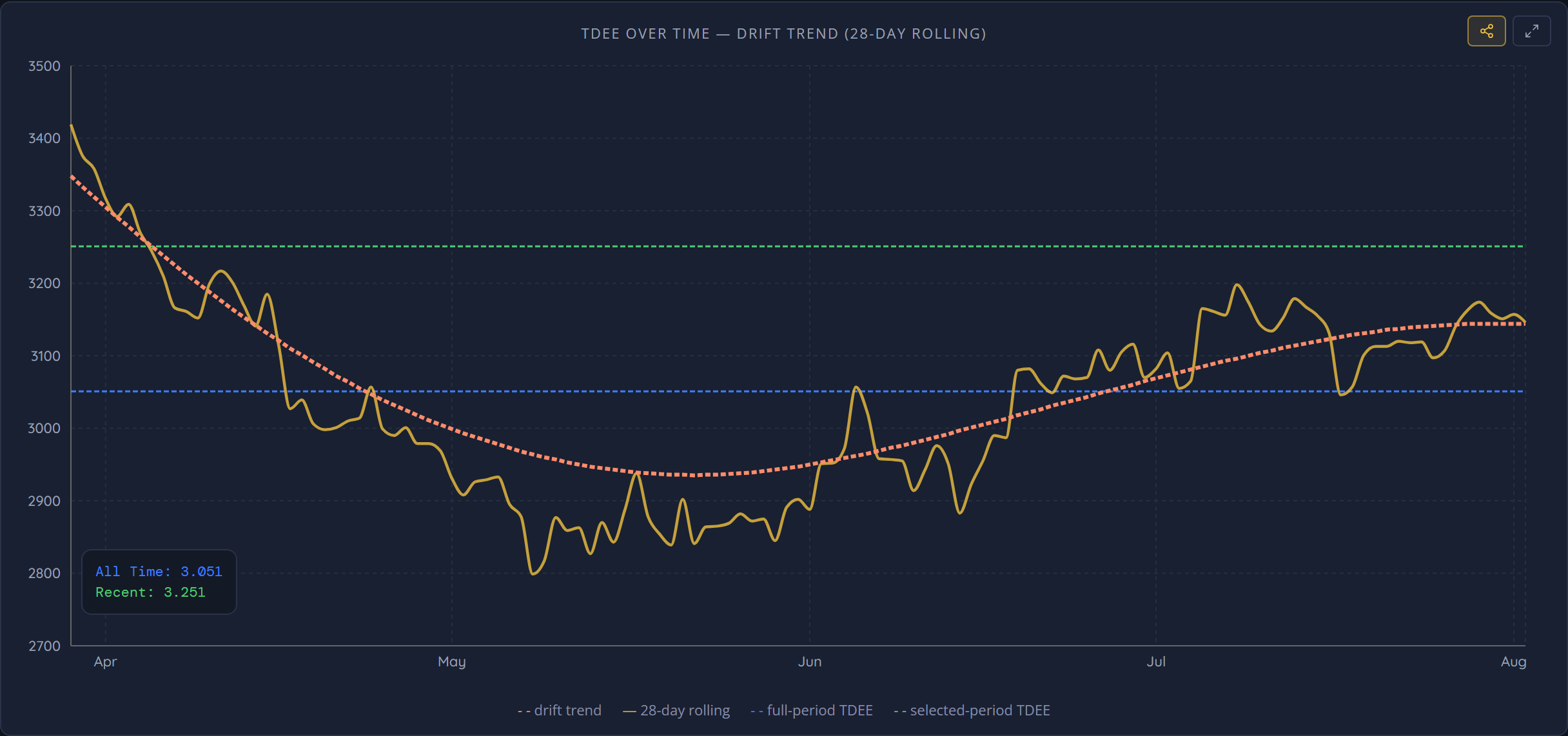
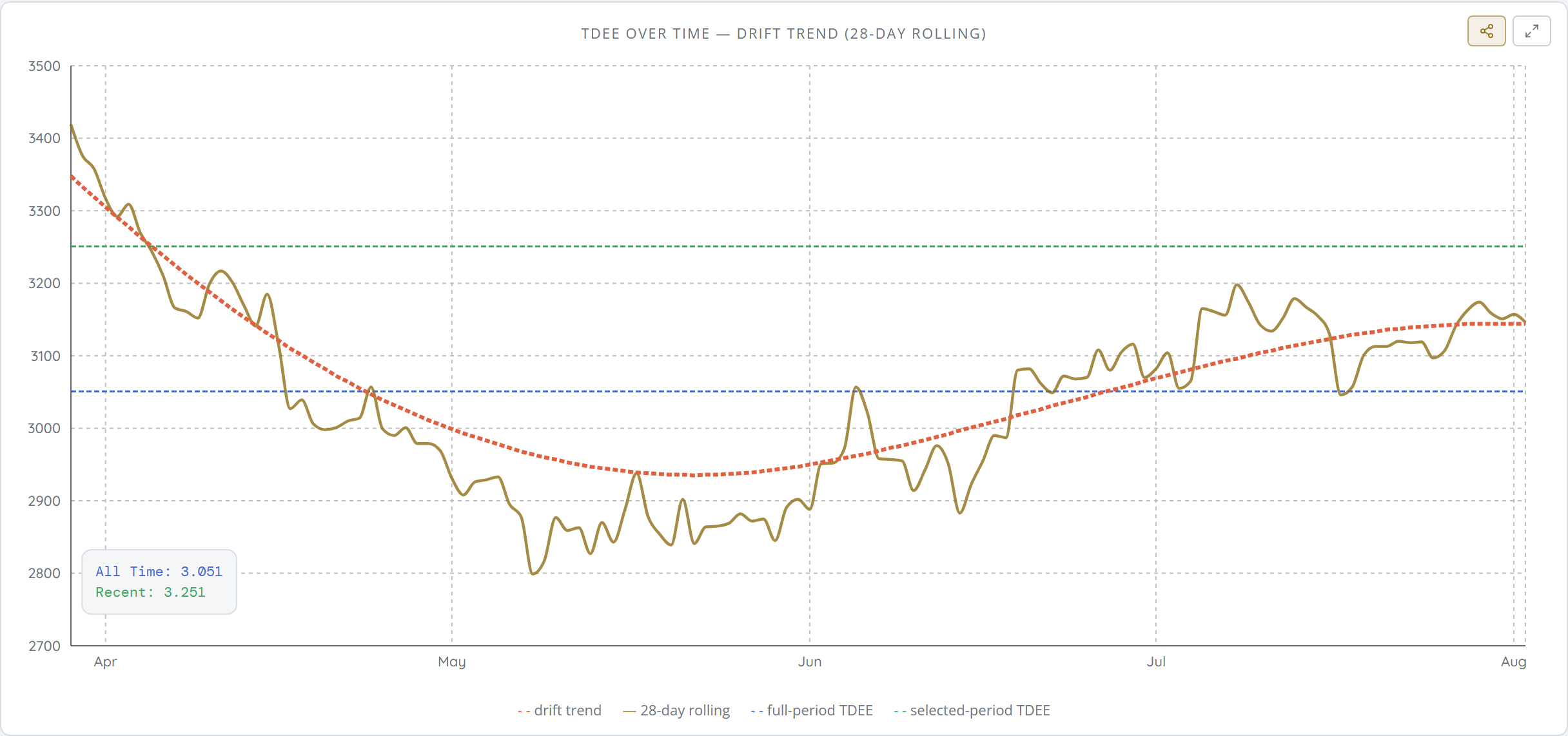
The moving target, drawn: my burn falling through the diet, then climbing back as I ate more. No formula has ever seen this happen — your own data does.
So what do you do with a moving target?
You stop chasing the daily number and start reading the pattern.
Any single day's TDEE is unknowable — but the average over weeks is remarkably steady and remarkably useful. String enough days together and the noise (the fidgety days, the rainy Sundays, the big dinners) averages out, leaving the underlying rate your decisions can actually stand on. Better still, an average computed from your own ongoing data keeps up: when your body adapts, the number follows, and you can see it happen instead of wondering why the old number stopped working.
That's also why TDEE is worth watching even after you reach your goal. It will keep drifting — with age, with activity, with life — and a number you measured once is a number that's slowly going stale.
The practical upshot:
- A calculator estimate is a starting guess, built from population averages — often wrong by hundreds of calories, and blind to every adaptation described above.
- Your own data is the real instrument. Weight trend plus intake over weeks reveals what you actually burned — see how to find your real TDEE from your own data.
- Expect the number to move, and plan for it. A deficit that stops working didn't fail — the target moved, and weeks of data will show exactly where it went.
- Keep the deficit modest. Setting your deficit deserves its own guide, but the short version: bigger is not faster. A large deficit is exactly what triggers the adaptations above — TEF falls with the missing food, NEAT quietly dials down, adaptive thermogenesis eases your BMR lower, and even your training can lose its edge — so the aggressive plan buys less than it promises and costs more to sustain. The Navy SEALs have a saying that fits dieting perfectly: slow is smooth, and smooth is fast. A moderate deficit you hold for months beats a brutal one you abandon in three weeks — every time.
What we're really talking about, in the end, is finding your patterns. It's almost research: your body is the subject, your daily logs are the measurements, and the weekly trend is the finding. Instead of borrowing conclusions from a study of average people, you run the study on the one person the answer is actually about — you.
That research is exactly what Metabolistic is built to do: it takes your own weight and intake logs and does the science part for you — the smoothing, the energy-balance math, the trend charts — so your TDEE is always today's measured number, never a stale guess.