Why Metabolistic exists
Getting very lean seems like the most difficult thing in the world. Only 0.1% of the population has a six-pack, and lately people have been turning to drugs like GLP-1s — because the conventional way, willpower against hunger every single day, feels impossible.
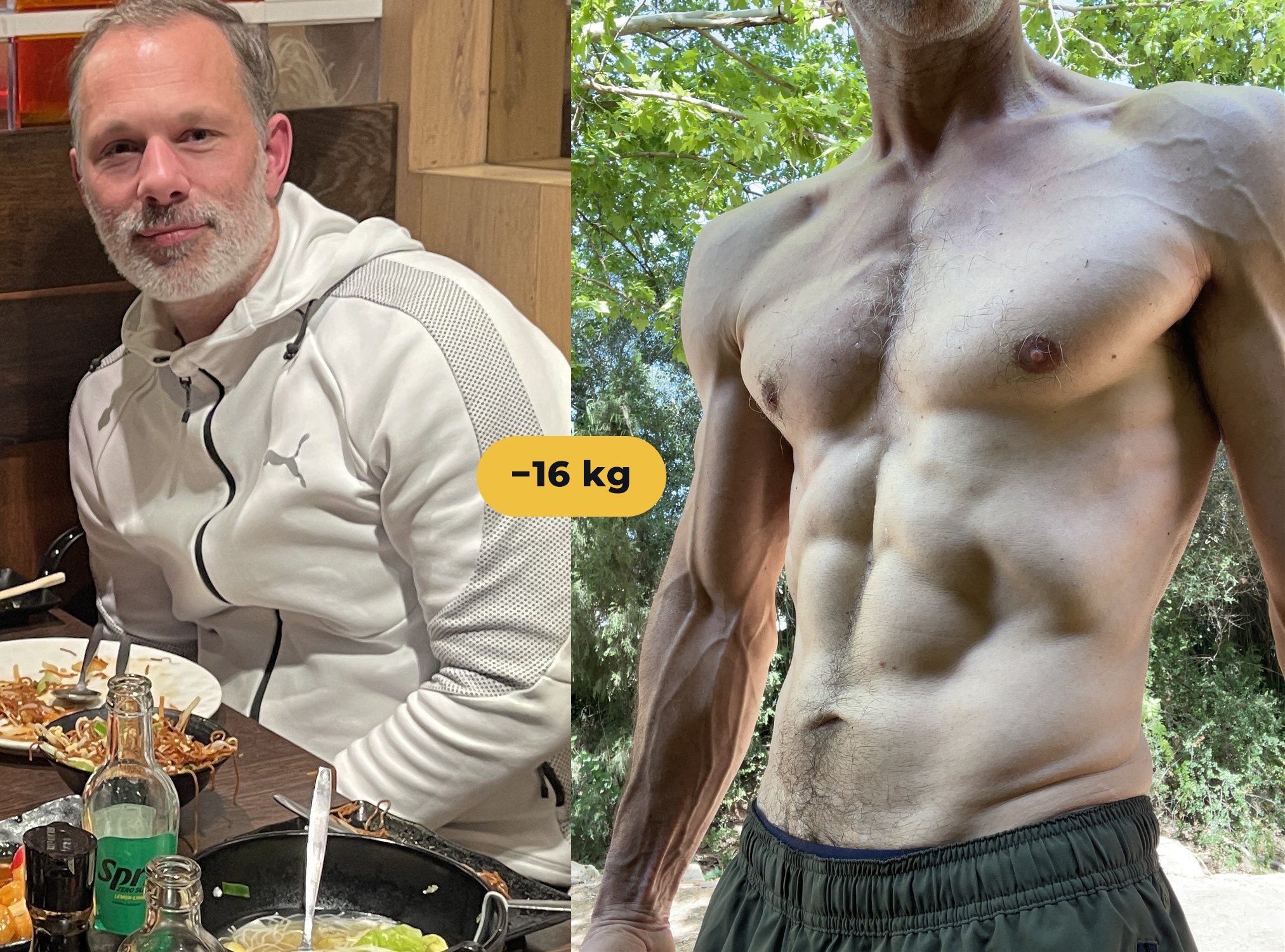
Six months and sixteen kilos apart.
I struggled with losing weight for a long time too. After quitting basketball in my twenties (almost thirty years ago T_T), which I played six times a week, it seemed gaining weight was all I could do.
At the end of last year I crossed a line — 92 kg — that triggered me to really commit to losing my excess weight. I was already inspired by TikTok legend Danijel Lizačić (@lizokryptonianreborn0), who had made clear that the essence of getting lean is really straightforward: eat fewer calories than you burn on a day-to-day basis, and keep doing that until you're happy with how you look. That's it. Nothing complicated about it. Right?
Right... until I jumped in. Because what is "less than I burn"? What do I even burn? I didn't know.
So let's use the "free calculator". It said that with moderate exercise (3–5 times a week) I should burn about 2,800 calories for my age and size. Okay. So let's start the diet at 1,900 calories. That's a 900-calorie deficit — pretty big, but at least I'll go fast (because I have a lot to lose).
Six weeks in, I had lost about 6 kg — but now I was cold all the time. Like, ALL the time. I even woke up several times a night because I was so cold. Not good. Not maintainable. ChatGPT said to eat a little more for a while, maybe even at maintenance for a few days, to get my metabolism going again. But what was my maintenance?
I stopped losing weight. I was totally lost and confused. What happened? What was I doing wrong?
Then it hit me. I didn't know what my daily energy expenditure was. Like, not at all. And, I realized, that might just be the most important number to know. Here I was, counting every gram of everything I put into my mouth. Weighing myself daily. Reading blogs, watching gurus give advice about this, that and the other thing. But the one thing I really had to know was about myself — and I didn't have a clue.
So I sat down, created a spreadsheet and threw my data together. Then I started making tables and graphs and calculations, and doing what I've done all my professional life: I built a dashboard to manage my input, output and outcomes.
But I hit a snag when it came to my TDEE (Total Daily Energy Expenditure). All the usual methods — rolling averages, monthly changes — didn't give me what I needed: a somewhat consistent number that moved, but not too fast and not too slow. Because my energy needs might differ from day to day, but they should be fairly stable over a four-to-eight-week window, as long as I kept up my regular lifestyle.
Eventually I gave up on doing it by hand and started up Claude. Together we found a few scientific ways of calculating metabolic rate that made much more sense. So I started calculating it daily — and used those calculations in my spreadsheet, to make more tables and graphs.
But using AI and then Excel was cumbersome. So I sat down with Claude once more, and we built metabolistic.com. This made it easy for me to use it all the time, and to see updates as soon as I added new data.
What happened next is that I finally got in control of the diet. I saw what was happening, regardless of whether the scale moved that day or not. I saw the path unfolding, and it all clicked into place.
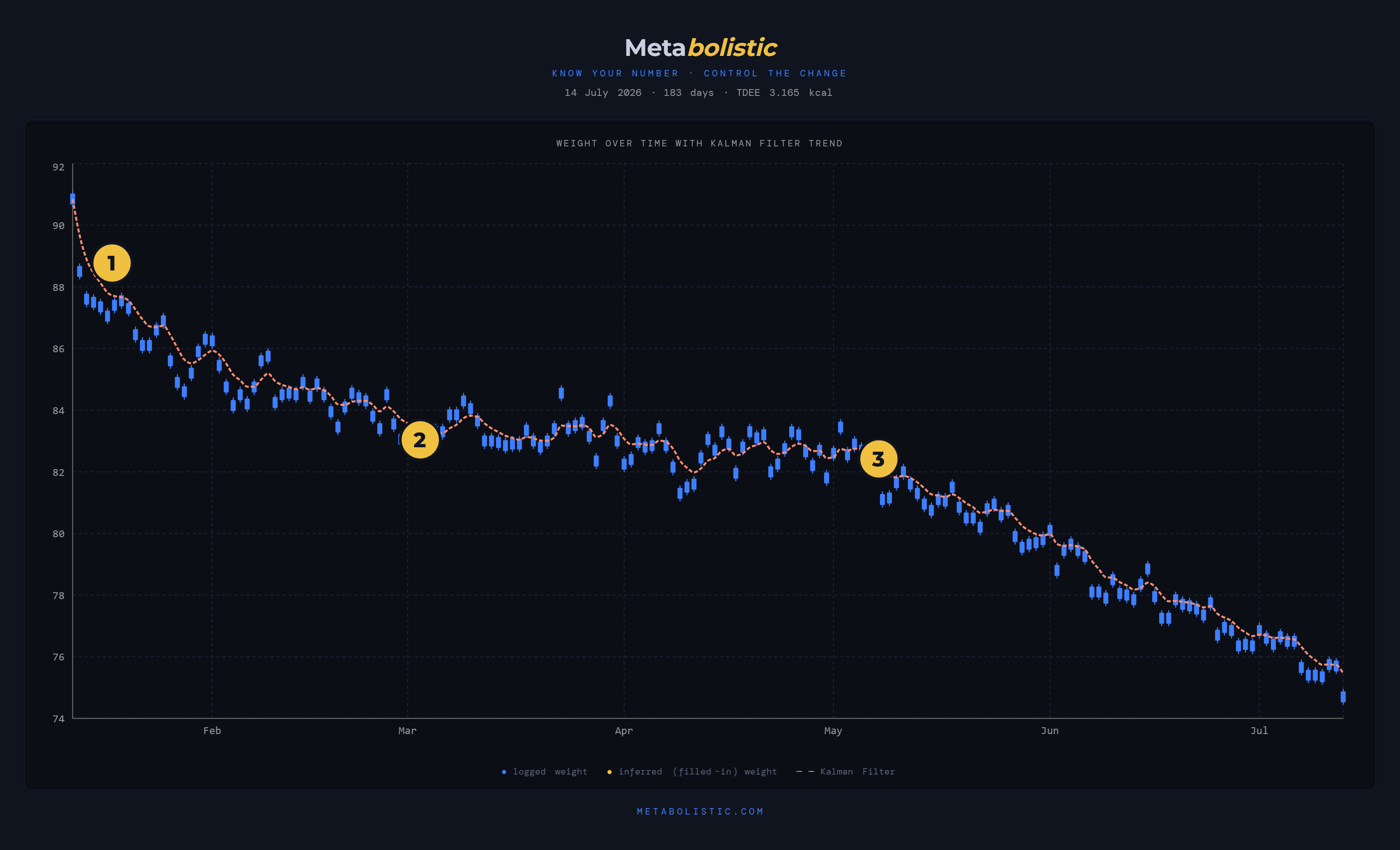
The whole journey in one chart — 1 started with desire and discipline, 2 got too cold and upped my calories, 3 started using the application. See the consistency after that third marker? It became easy.
I had stumbled into a "new method" that actually worked. And not only that — it made it easy! It changed everything.
No longer was I "trying to stick to my diet" in a day-to-day war of hunger versus me. No longer was it hard to skip that one extra snack before bed. Because I knew: whatever I chose, it would show up in the dashboard tomorrow. It would move my averages, and either extend or end my streaks.
Most trackers are mirrors — they show you what you ate, what you walked, what you slept. Metabolistic is more like a map — one you use to plot and track your journey. It shows your true daily energy expenditure, your true deficit, and the path you're actually on. It's the one tool that puts you at the center.
It helped me in a few ways:
1. It gave me daily feedback on my actions, regardless of whether the scale showed it in the morning.
2. It showed me the relationship between my actions (input), output (TDEE) and outcome (my weight).
3. It made my daily choices "more meaningful", as they all added up to tell a story: my averages, my progress, my streaks.
4. And it made it fun! I wasn't "losing weight", I was "managing my dashboard" and "making the numbers go up and down". It changed the struggle into a game, where small good decisions added up to progress beyond my wildest expectations.
And not only did it help me — my friends started using it as well, and were super excited. They started sending me pictures of the dashboard and their progress. They started improving their diets and upping their exercise, to increase their TDEE. They were doing all the things I started doing, once I saw the connection between input and outcome.
That's when I realized I needed to go public with this tool. So here it is.
I hope you find it as useful as I did — and that you achieve whatever goals you set for yourself. Good luck, and if you have any feedback or ideas about the application, please let me know via the contact form.