Be your own fitfluencer
Here's an uncomfortable thing about fitness advice: all of it is general.
Not some of it. All of it. The influencer with the shredded physique and the four million followers, the researcher with the meta-analysis, the coach with twenty years of client transformations, the well-meaning friend at the gym — and yes, me, right now, in this article. None of us know you. We have never met your body. Everything any of us can possibly tell you is, by definition, advice for a category you belong to: humans, dieters, people-who-want-abs. It is true-on-average, which is a polite way of saying it is precisely true of almost no one.
That's not a flaw in the advice. That's just what advice is. It can't be anything else.
Knowledge is dead
I want to push this further, because I think it's the actual point and not just a caveat.
Knowledge — the article, the protocol, the macro split, the "optimal" rep range — is dead. I don't mean useless. I mean dead in the way a map is dead: it's ink on paper. It doesn't walk the terrain. It was drawn from other people's journeys, averaged and flattened until it fit on a page. A map can be accurate, valuable, even beautiful. What it can't be is alive.
You, on the other hand, are alive. You're the one with the actual metabolism, the actual schedule, the actual knees, the actual relationship with the contents of your fridge at 11pm. Doing is what living beings do — and applying something, watching what happens, and adjusting is not a downstream detail of the knowledge. It's the part where the knowledge becomes real at all.
So the division of labor is fixed, and it was never negotiable: the outside world supplies the general. Only you can make it specific.
The transformation nobody can sell you
Look at what happens when general advice meets an actual person.
"Most people do well on a 15% deficit" — general. Whether you do well on it depends on your body, your training, your sleep, your stress, and whether the plan survives contact with your actual life. I've written elsewhere about how to set a deficit, and if you read that article carefully you'll notice something: every layer of it ends in a question only your own results can answer. Your real maintenance isn't in a table — it's in your own data. Your best deficit isn't the optimal one — it's the one your body tolerates and your life sustains. Your ideal protein intake, meal timing, training split: same story. The general advice narrows the search space. It cannot do the search.
That last step — from "works for most people" to "works for me, like this, under these conditions" — is the entire transformation. And it is exactly the step no influencer can perform for you, at any price, at any follower count. Not because they're frauds (though the incentives don't help), but because they are structurally on the wrong side of the map/terrain divide. They have the map. You are the terrain.
What the outside world is actually for
None of this means unfollow everyone and eat by intuition alone. Dead knowledge is still knowledge. Maps are still worth reading — I'd rather start a journey with one than without.
The move is smaller and more precise than rejection: demote the advice from verdict to hypothesis. An influencer's protocol isn't an answer; it's a suggestion for your next experiment. A study isn't a command; it's a hint about where to look. Inspiration and information — that's the honest job description of every outside source, mine included. The moment you treat any of them as more than that, you've handed off the one role that was yours.
And how do you run the experiment? The same way anyone runs one: you decide what you're testing, you apply it for long enough to matter — weeks, not days — and you watch what actually happens. Your weight trend, your intake, your energy, your mirror. Measurements beat testimonials, and your own measurements beat everything, because they're the only data on Earth that's about the subject in question.
That's it. That's the whole method. Try, measure, keep what works on you, discard what doesn't — no matter whose name was attached to it.
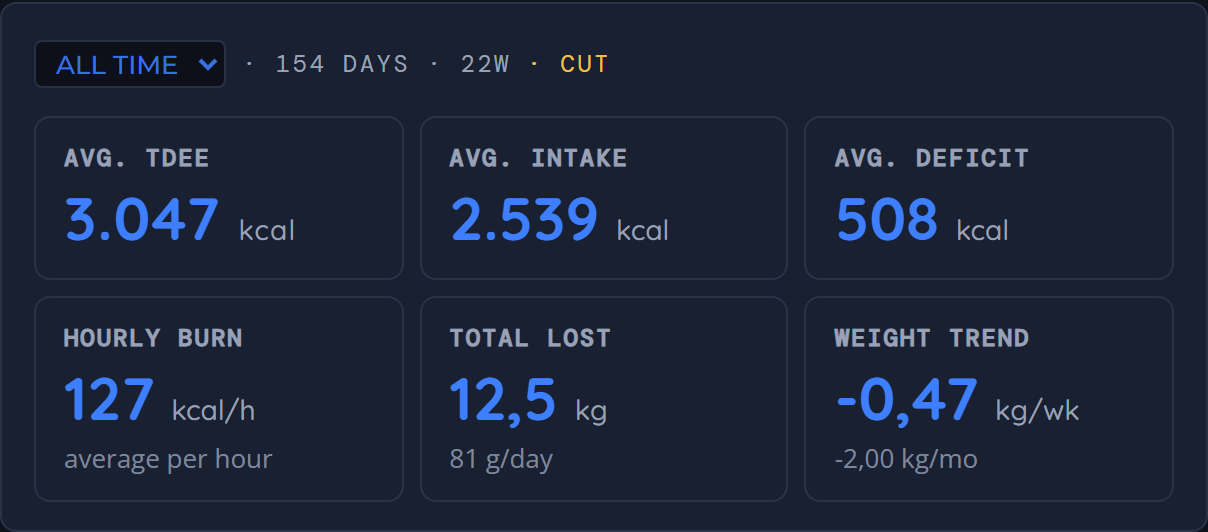
This is what being your own expert looks like as a readout: your burn, your intake, your deficit, your trend — one subject, measured.
The only expert on you
Here's what happens when you work this way for a while, and it's the part I actually care about: you stop needing the feed.
Not because you know everything — you won't, I don't — but because you've built the thing no one could give you: a working model of your body. You know what your maintenance really is, because you measured it. You know which deficit you can hold through a bad week, because you've held one. You know what happens to your training when you cut carbs too far, because you did it once and watched it happen. New advice stops being a revelation and becomes what it always was: input. Interesting, maybe. Testable, always.
The follower relationship runs on the opposite arrangement — the answers stay out there, and next week there's a new protocol, a new optimal, a new reason you still need the feed. I'd rather you graduate. Somewhere out there is exactly one person with full-time access to the subject, a lifetime of inside information, and an unlimited research budget of lived days.
You might as well take the job. It was always yours anyway.
Metabolistic is built for exactly this job: it turns your own logs into your own numbers — your real maintenance, your actual deficit, your trend — so every experiment you run has a readout. No guru, no protocol-of-the-week; just your data, telling you what works on you.