The TDEE calculator trap: it treats you like a constant
Almost every diet starts the same way: you find an online TDEE calculator, type in your height, weight, age and an "activity level," and it hands you a number — say, 2,300 calories. You subtract 500, start eating 1,800, and off you go.
Here's the problem: that number was a guess about the average person your size — and you are not the average person your size. Two people with identical stats can differ by several hundred calories a day in what they actually burn. The formula cannot know which one you are. It has never met you.
The error you start with
Population formulas (Mifflin-St Jeor, Harris-Benedict and friends) are accurate on average across a population — which is a statistician's way of saying they can be significantly wrong for any individual. Then the "activity level" multiplier stacks a second guess on top: be honest, do you know whether you're "lightly" or "moderately" active? Almost nobody does. Pick wrong and you've added another few hundred calories of error in either direction.
This isn't hypothetical. I built Metabolistic after starting my own diet with a calculator that turned out to be about 350 calories under my real burn. The "sensible" 850-calorie deficit I thought I'd chosen was actually a brutal 1,200-calorie one — the kind that leaves you cold, exhausted, and convinced that you are the problem. I wasn't. The number was.
The error that gets worse
Even if the calculator nailed your number on day one, there's a deeper flaw — one that's built into what a formula is:
You are on a diet to change yourself. The calculator treats you as a constant.
As you lose weight, your body adapts. You carry less mass, so everything costs less energy. Your body also downshifts in subtler ways — less fidgeting, lower heat production (ever been cold all the time halfway through a diet? that's it), a somewhat thriftier metabolism overall. This is called metabolic adaptation, and it's normal, not "starvation mode" and not damage.
Now ask: what does the calculator do with any of that? Nothing. Your height didn't change. Your age barely did. Your "activity level" checkbox is the same. So it serenely repeats the same number while your actual burn drifts away from it. It isn't just imprecise — it is structurally blind to the one thing a diet is guaranteed to do: change you.
Guiding a diet with a generic calculator is like planning a road trip with a photo of your driveway.
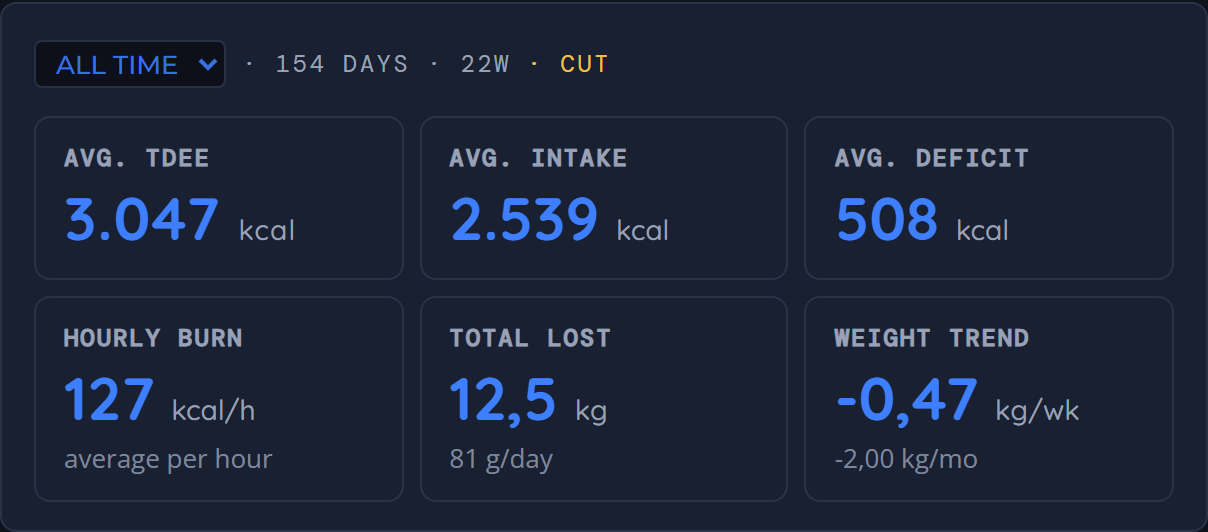
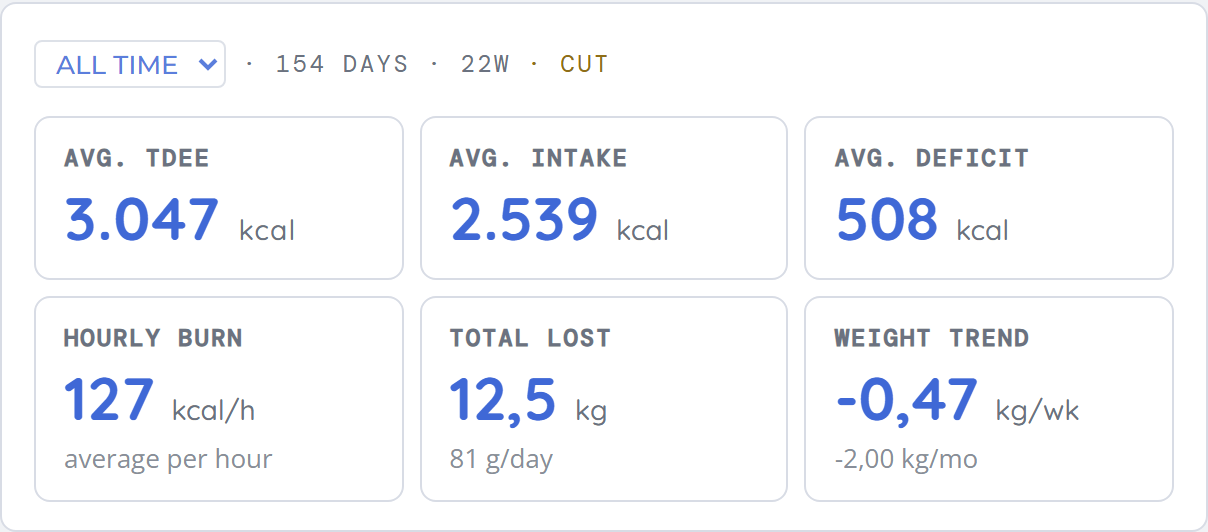
This is what replaces the calculator's guess: one number, measured from my own log, with the deficit it implies sitting right beside it.
What to use instead: your own data
Here's the good news, and it's genuinely good: if you're weighing yourself and logging your food, you already have everything needed to measure your real burn. No lab, no formula, no guessing.
The logic is simple energy balance. Over a stretch of weeks, if you know how much you ate and how your weight actually changed, the difference tells you what you burned. Eat 2,200 a day for six weeks and lose weight at a steady clip? Your real maintenance must be higher than 2,200 — and the rate of loss tells you exactly how much higher. That's not an estimate of people like you. That's a measurement of you.
And unlike the calculator, this number keeps up. As your body adapts, your data shows it — you can literally watch your burn change over the weeks, on a chart, instead of wondering why the old number stopped working.
The takeaway
- A calculator's number is a population guess; treat it as a starting hypothesis at best, never the truth.
- Even a correct number goes stale, because dieting changes your metabolism — and formulas can't see change.
- Your own logs — weight and calories over weeks — measure the real thing, and keep measuring it as you change.
Metabolistic computes your real burn from the weight and calories you already log — and keeps computing it as you change.