Your TDEE has a shelf life
I built this app around TDEE. I talk about it constantly. Know your number is more or less the whole pitch.
And for about four months I was reading my own number wrong — proudly, because it kept going up.
The number I was looking at was my all-time average: every day I had ever logged, rolled into one figure. It climbed month after month, and I treated that like a trophy. Meanwhile the burn I actually had that day was sitting roughly 290 calories above it. Every deficit I set from that trophy was 290 calories deeper than the one I thought I was setting. For four months. By the person who made the app.
I want to be very clear that the number wasn't wrong. It was a perfectly good average. I was just spending it on the wrong question.
Average speed is not current speed
Here is the version that finally landed for me.
Imagine a long drive. You've been going four hours, you've covered 320 kilometres, so your average speed is 80 km/h. That figure is completely correct. It is also useless for the only decision in front of you, which is whether to lift your foot — because right now you're doing 130 through a village.
I was using my average speed as my current speed and wondering why I kept getting tickets.
That's what a long-run TDEE average is. It's an odometer reading. It tells you what the trip has cost so far. It cannot tell you what you're doing now, and today's plate is a now decision.
More data usually helps. This is the exception.
Everything in your instincts says more data is better, and normally it is. Weigh yourself thirty times instead of three and the average gets closer to the truth. That's how measurement works.
It's how measurement works when the thing you're measuring holds still.
Yours doesn't. You are a living system, and if you're dieting you are changing that system deliberately, every single day:
- You weigh less. A smaller body costs less to run. That alone moves the number.
- Your composition shifts. Less fat, hopefully similar muscle — a different machine, not just a lighter one.
- Your spontaneous movement drifts. Eat less for long enough and you fidget less, stand less, take the stairs less. Nobody decides this. It just happens.
- Your training changes. So does your sleep. So does your stress.
- The world changes around you — which I'll come back to, because it's the part almost nobody accounts for.
So the data from three months ago isn't wrong data. It's data about a different person. Averaging them together gives you an extremely accurate answer about someone who no longer exists.
My own record makes the point better than I can. Across seven months my monthly burn ran roughly 3,317 in January, down to 2,835 in April, back up to 3,599 in July. That's about 760 calories from top to bottom — in one person, in one year, on one continuous diet. Averaging those into a single number gives you a figure that was never true on any day of it.
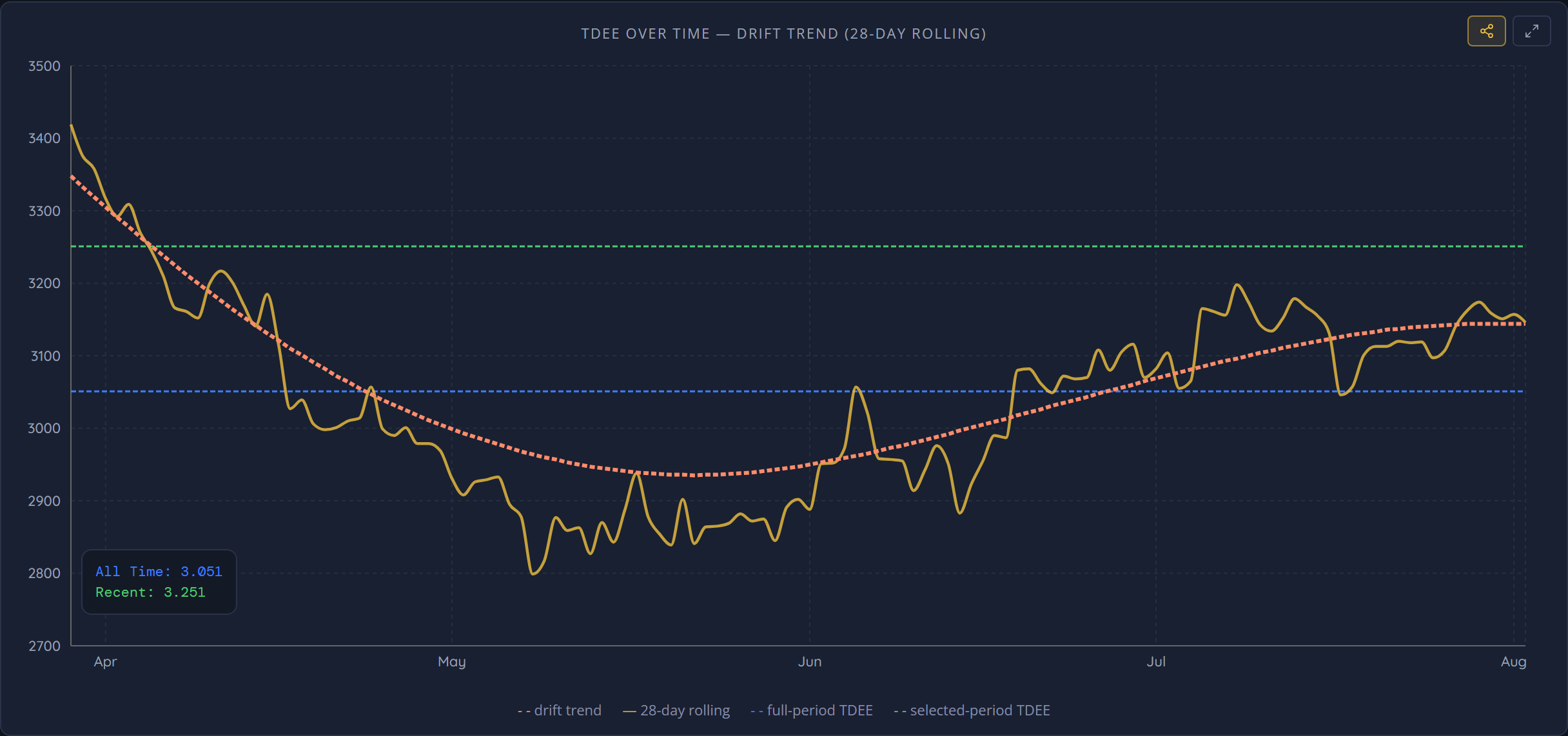
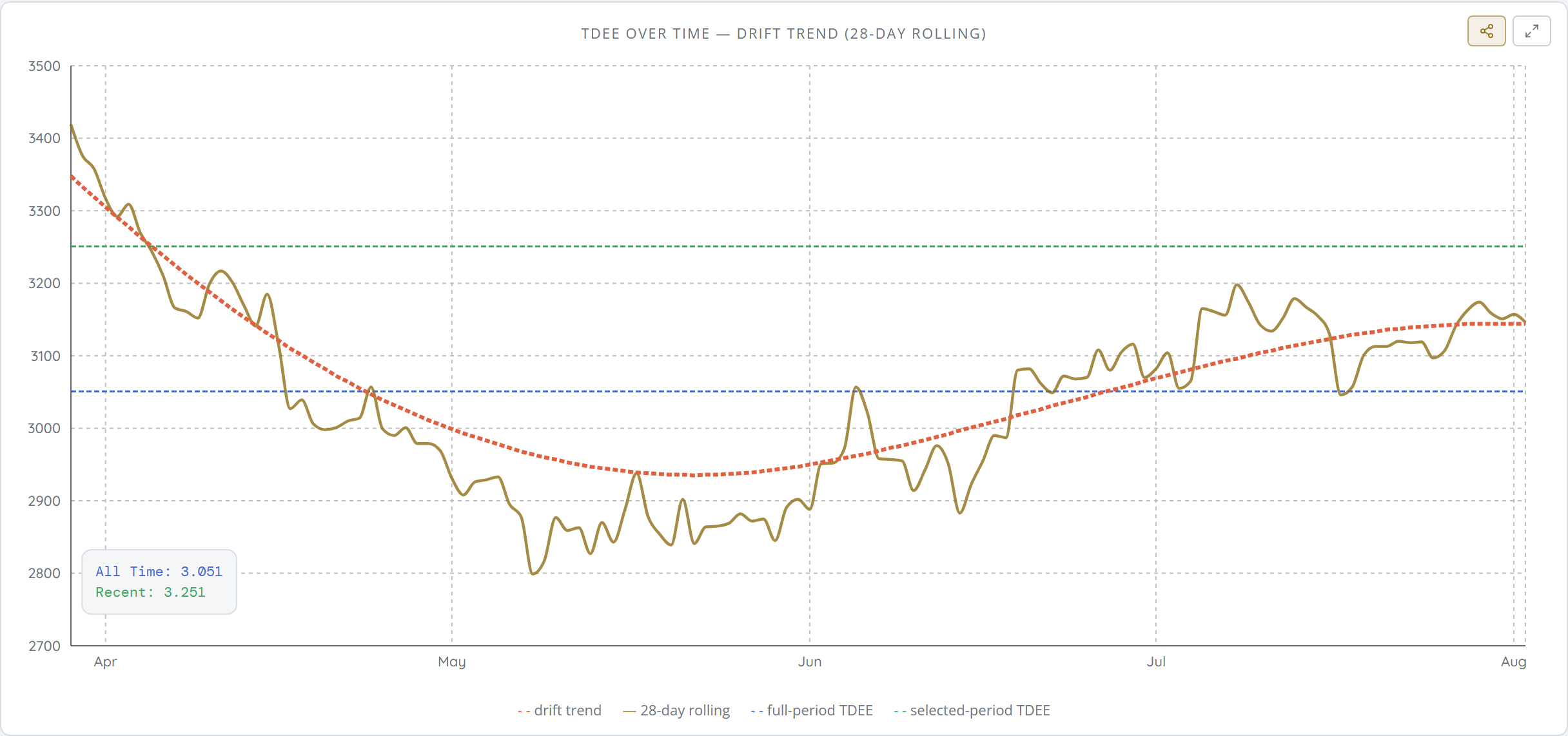
My own burn over seven months: falling through the diet, then climbing back as I ate more. Every point on this line was true once. Only one of them is true today.
The two kinds of noise
This is the part I find genuinely tricky, and I think it's the real content of the whole subject. There isn't one enemy here. There are two, and the cure for each one feeds the other.
Noise one: the scale wobbles
Your weight moves for a dozen reasons and you only care about one or two of them — fat, maybe lean mass. Everything else is water, salt, glycogen, food still in transit, what time you stepped on. Half a kilo of morning-to-morning swing is completely ordinary and completely meaningless.
You cannot see fat directly. You have to infer it from a signal that jitters. And because a kilo of body weight represents something like 7,700 calories, a small wobble in the line becomes a large wobble in any burn calculated from it.
The cure for this noise is more days. Random error cancels. Give it enough data and the jitter averages out.
Noise two: the past goes stale
But every extra day you reach back to fight the jitter is another day of a person who isn't you anymore. That isn't signal either. It's a second kind of noise — and it's worse, because it doesn't cancel.
Scale noise scatters in both directions, so it washes out. Staleness pulls in one direction: toward whoever you used to be. Add more of it and you don't get a fuzzier answer, you get a confidently wrong one. Which is exactly what happened to me — the more data my all-time average accumulated, the further it drifted from the man standing on the scale, and the more authoritative it looked while doing it.
So the two cures fight:
Too little data and you're reading water. Too much and you're reading history.
That's the balance. It is not a detail, and there's no setting that makes it go away. There's only a sweet spot — enough days to see through the jitter, not so many that you're averaging in a stranger.
One number, two questions
Once you see the trade-off, you notice you've been asking one number to do two incompatible jobs.
"What did this journey cost me?" — a long average is exactly right here. The more data the better, genuinely. It's a record. It's the honest summary of a stretch of your life, and it's the number worth being proud of.
"What does my body need today?" — a long average is exactly wrong here. This question needs a reading, not a history. It wants to know about the machine as it is currently configured, and it wants to be re-answered as that changes.
Both numbers are true. Neither is a better version of the other. My mistake was never computing the average — it was spending it, on a question it was never built to answer.
This is why the dashboard now separates them physically: where you are right now on top, where you have been underneath, so you can't accidentally read one as the other the way I did. Here's how each of those numbers is actually calculated, if you want the mechanics.
Even maintenance doesn't get a pass
You might think this is a dieting problem — that once you're stable, one good number holds.
Picture maintaining for a full year instead. January you're indoors, moving less, sleeping differently, eating differently. July you're outside constantly. The seasons don't just pass around you; they pass through you. Your training shifts, your daylight shifts, your appetite shifts, your commute shifts. A maintenance number you established in February will be quietly wrong by July — and because nothing dramatic happened, you'll blame yourself rather than the number.
That spring ramp is visible in my own data as a clear climb. Nothing about my diet explains it. The year does.
What I do now
Nothing complicated. Four habits:
- I set today's deficit against a current estimate, never against a career average. The average is the trophy shelf; it doesn't get a vote on dinner.
- I keep the long average for the story. Progress reports, the shape of the whole diet, what six months actually cost. It's excellent at that, and I look at it far less often than I used to.
- When the two disagree, I treat it as the finding, not the fault. A gap means my burn has moved, and the direction of the gap tells me which way. It's information I paid for by logging; I may as well collect it.
- I re-check after anything changes. New phase, new season, new training block, a holiday, an injury. Not because the number broke — because I did the thing that moves it.
And the meta-lesson, which is really the same lesson this whole site keeps arriving at: your body is not a spec sheet you look up once. It's an ongoing measurement. The point of logging isn't to finally pin down The Number. It's to always have a current one.
Your TDEE has a shelf life. It's shorter than you think, and it always has been — you just couldn't see it before, because you had nothing to compare today against.
Metabolistic keeps a live estimate of what you burn today, right beside the long averages that describe your journey — so you can see the two drift apart, and know which one to plan with. Try it with demo data.