Keep logging: your log is the only honest mirror you have
Three things lie to you about your own body, every day.
The mirror lies. It runs on light, angle, sleep, salt and what mood you woke up in. I have looked lean and looked soft in the same bathroom four hours apart.
The scale lies — on any given morning. A kilo of overnight swing is normal and almost none of it is fat. You already know this and it does not help, because the number still lands in your chest before your brain gets there.
And your memory lies hardest of all. Ask me what I ate last week and I will tell you "pretty well, honestly." My log will tell you about Thursday.
I'm not going to pretend I've beaten any of these. I built this whole app and I still read the mirror on a bad morning like it's data. What I have is one thing that doesn't lie, and it isn't willpower.
You cannot influence what you cannot see
The whole idea behind this app is that you control the input and the outcome follows. That's the pitch, and I believe it.
But there's a step underneath it that nobody says out loud: you can only control an input you can actually see. Everything upstream of that is guessing. You can't tighten a deficit you can't measure. You can't tell whether a change worked if the record of the change is a vibe. You can't argue with the mirror — it doesn't take evidence.
Your log is the only real reflection of reality you get. Not the truest one of several. The only one. Everything on your dashboard — your burn, your deficit, your trend, the projection with a date on it — is reconstructed from those two little numbers you write down each morning. That's not a limitation of the app. That's what makes it yours instead of a calculator's guess about a stranger with your height.
So when I say keep logging, I'm not asking you to be disciplined. I'm telling you where the light switch is.
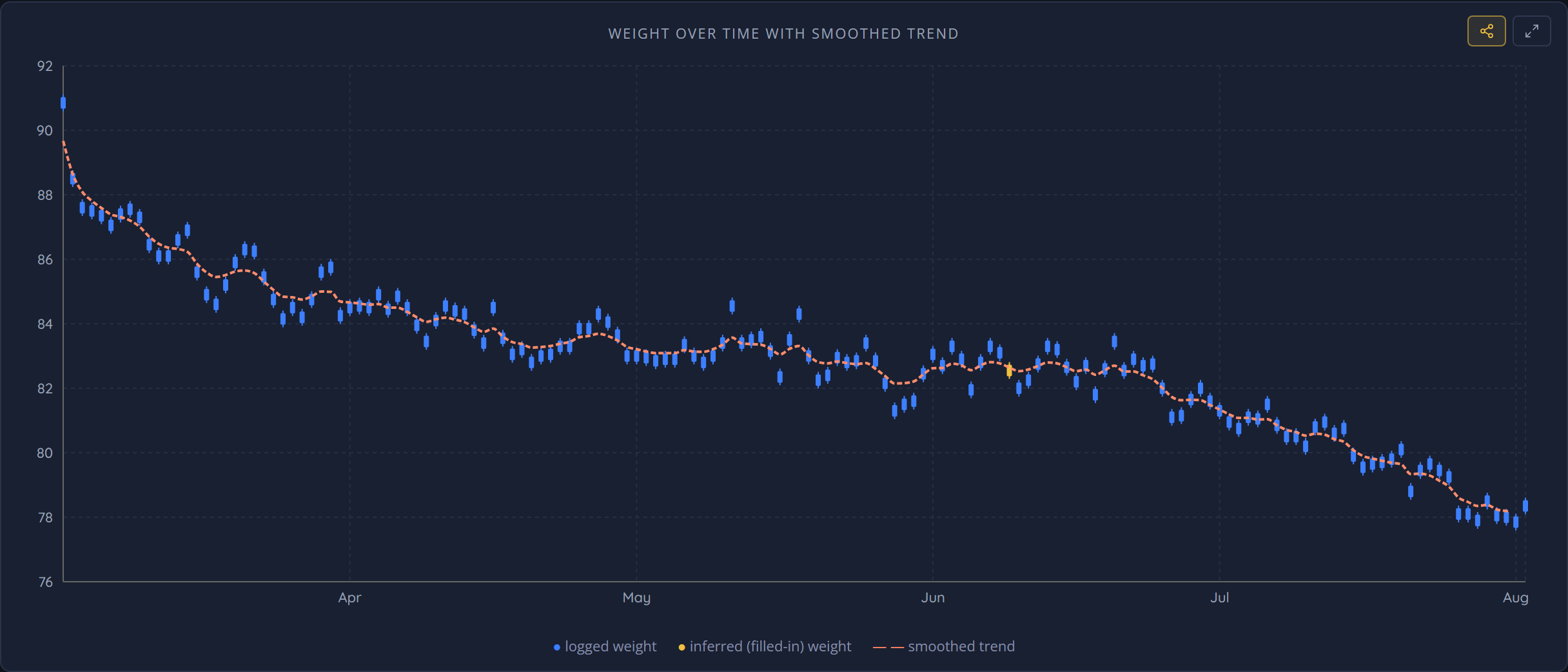
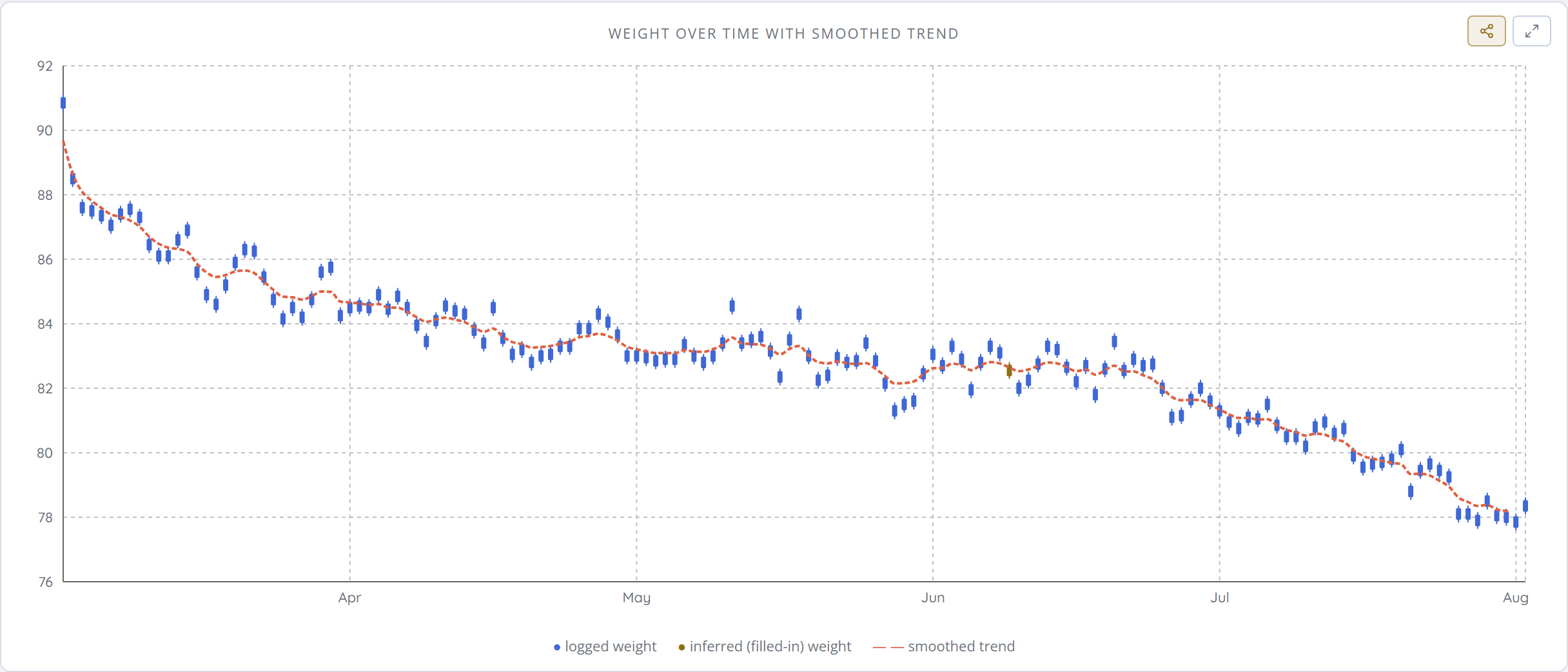
Every one of those dots is a morning I stood on a scale and wrote a number down. The line through them isn't magic — it's just what happens when you keep showing up. Take the dots away and there is nothing for it to be made of.
What actually happens when you stop
Here's the part I owe you honestly, because "just keep logging" from a guy with an app is exactly the kind of thing you should be suspicious of.
I went and measured it. I cut holes in real records and in test records where I knew the true answer, and ran them through the exact machinery this app uses. I wanted to know what a missed week really costs, rather than what it feels like it should cost.
The answer surprised me, and it's good news first:
While you're away, almost nothing goes wrong. Stop for a week, a month, three months — your dashboard doesn't collapse, your history doesn't corrupt, and the number you left behind stays about as good as it was. Nothing is punishing you for the gap. There is no decay meter.
The bill arrives when you come back. And it's bigger than you'd guess. After a month away, the first thing this app will tell you is that you burn roughly 600 calories less than you actually do. After two months off, closer to 900. Then it spends about six weeks slowly climbing back to the truth while you make decisions from a number that's too low.
That is a genuinely bad outcome and I want to be plain about why it happens, because the reason is the whole point of this article.
Your holiday gets billed to your metabolism
The app works out what you burn by comparing what you ate against what your weight did about it. Both halves are required. That's the deal — it's arithmetic, not opinion.
Now take three weeks off. You come back and step on the scale two kilos heavier. The app can see the two kilos. It cannot see the three weeks of eating, because you didn't write them down — so it does the only thing it can, and assumes you carried on eating roughly what you were eating before, which was your diet intake.
Two kilos gained. On a cutting intake. There is exactly one arithmetic that fits: your metabolism must have fallen off a cliff.
It didn't. You had a holiday. But the app wasn't there, and it will not invent data you never gave it — that's a promise it keeps in both directions. So your three good weeks of eating pizza get quietly charged to your metabolism, and you come home to a dashboard telling you your body is broken.
It isn't judging you. It's doing careful arithmetic in an empty room.
A rough guess beats a blank
This is the bit that changed how I think about my own log, and it's the most useful thing in this article.
I tested every way of repairing a break I could think of. Weighing yourself through the holiday: doesn't help at all. Not a little — at all. The weight was never the missing piece.
What fixes it is a guess at what you ate. Not a good guess. I tried it with guesses that were 20% wrong, which is a wilder margin than anyone's honest estimate of a holiday, and the six-week recovery dropped to about ten days. Then I tried the laziest thing imaginable — one single flat number typed into every day of the break, "call it 3,000, whatever" — and it came back to the truth in three days.
Think about what that means. The difference between six weeks of being lied to and three days of being right is not accuracy, effort, or discipline. It's presence. The app doesn't need you to have logged well. It needs you to have been there at all.
A day with a rough number in it is a day the arithmetic can use. A blank day is a day it has to guess about — and it always guesses that you were still dieting, because that's the last thing it saw you do.
So log badly, if that's what's on offer
I think most people quit logging for the same reason: at some point they eat something they don't want to write down. The log stops being a record and turns into a report card, and nobody keeps filing reports on themselves once the reports are bad.
So let me take the report card away.
Your log is not a scorecard and it is not adherence points. It's an instrument. An instrument that records a 4,000-calorie Saturday is working perfectly — that Saturday is real, it happened, it's part of the picture, and the honest number is worth ten times the flattering blank you'd leave instead. The app has no opinion about your Saturday. It just needs to know.
And a guessed number is a real entry. "I don't know, maybe 3,200" is data. The best log I could design for you would not be a perfect one — it would be an unbroken one, full of shrugs and rough numbers and days you'd rather not discuss.
The point isn't the app
Here's where I'll break the fourth wall, because this is a page on a website that wants you to use its product, and you should know when you're being sold to.
The reason I want you logging isn't that it keeps my charts fed. It's that after a few months of it, something happens that I did not expect when I started: you stop needing the charts to tell you. You start being able to feel the difference between a water week and a fat week, because you've watched the pattern enough times to recognise it. You develop a working model of your own body that is yours — specific, tested, not borrowed from anyone with a physique and a podcast.
That's the whole endgame. Not you checking a dashboard forever. You, eventually, being the only real expert on the only subject that matters here, which is you.
But you can't build that model out of nothing. It's made of days. Ordinary, unglamorous, honestly-recorded days, including the bad ones, especially the bad ones.
So write the number down, even when it's a guess, even when it's ugly. That's the whole practice, and it's the only part that can't be faked.
Metabolistic reads your burn, your deficit and your trend straight out of the days you log — and tells you plainly which days it's missing, so a gap stays something you can fix instead of something you find out about later. Try it with demo data.