Four-pack, six-pack, eight-pack: your abs were numbered before you were born
Here's a small scene that repeats in a lot of gyms and group chats: someone gets lean, a friend says "nice six-pack," and — if they've actually looked — they correct it: "it's a four-pack." Usually it's a joke. But go feel for yourself, now that the fat's gone and you can actually find the muscle, and you might notice something genuinely surprising: there's no third horizontal line down there. Not hidden. Not "not developed yet." Just not present.
That's not a flaw, and it's not something to fix. It's anatomy almost nobody gets told. The number of "packs" you can ever show — four, six, or eight — was decided before you took your first breath, and no exercise on earth will change it. Here's why, and what training can actually do.
It's not "more muscles" — it's one muscle with lines drawn on it
The "six-pack" isn't six muscles, or eight, or four. It's one muscle: the rectus abdominis, a single flat sheet running vertically from your lower ribs down to your pubic bone. Everyone lean enough has the same one.
What makes it look like separate blocks are the grooves:
- The vertical line down the centre is the linea alba — the seam where the left and right halves of the sheet meet.
- The horizontal lines are tendinous intersections — bands of tough fibrous tissue woven straight through the muscle, tethering it down at intervals. The muscle bulges between them; the bands stay flat. That contrast — bulge, groove, bulge — is what your eye reads as "packs."
So a "pack" is just a segment of one muscle, fenced off by these bands. Count the bands and you've counted the packs.
Why four, why six, why eight
The number of those horizontal bands — and how neatly they line up — is what sets your pack count. Most people have three tendinous intersections. Fewer or more is entirely normal:
- Four-pack — the lower bands are faint, incomplete, or simply absent. The top of the muscle divides cleanly into two rows; below that it runs smooth. Common, and completely healthy.
- Six-pack — the typical case, three bands. (Anatomically the muscle is often divided into a fourth, lowest segment too — but that bottom one sits low, near the navel, and usually stays flat and long rather than popping. That's why "three bands" so often reads as six visible bumps, not eight.)
- Eight-pack — an extra complete band low on the abdomen gives a fourth visible row. Rare, and mostly a genetic gift rather than a training trophy.
And here's the part the fitness industry never mentions: the bands often don't line up left-to-right. One side can sit higher than the other, giving a staggered, zig-zag look. That asymmetry is the default in a lot of people, not a sign you trained wrong. It's just how your fibrous bands happened to form.
The part no one tells you: you can't train the count
This is the honest, slightly liberating truth. Those tendinous intersections are connective tissue laid down while you were still an embryo. Their number, spacing, and symmetry are set — genetics, like your bone structure or the shape of your nose. No exercise reaches them. There is no crunch, no plank, no cable movement, no "lower-ab" secret that adds a band, straightens a crooked one, or turns a four into a six. Anyone selling you an "eight-pack workout" is selling you something you either already have or never will.
So what does training do? Two real things — and only these two:
- Lower body fat, to reveal what's there. Abs are hidden by the fat sitting on top of them. Getting lean is what makes the muscle — and its bands — visible in the first place. This is the lever that actually put your four-pack on display.
- Build the muscle, so it bulges more. Training the rectus abdominis makes the segments thicker, so the bulges pop harder and the grooves read deeper. A well-built four-pack looks far more impressive than a soft six.
What neither does is change the blueprint. You reveal your abs; you thicken your abs. You don't renumber them.
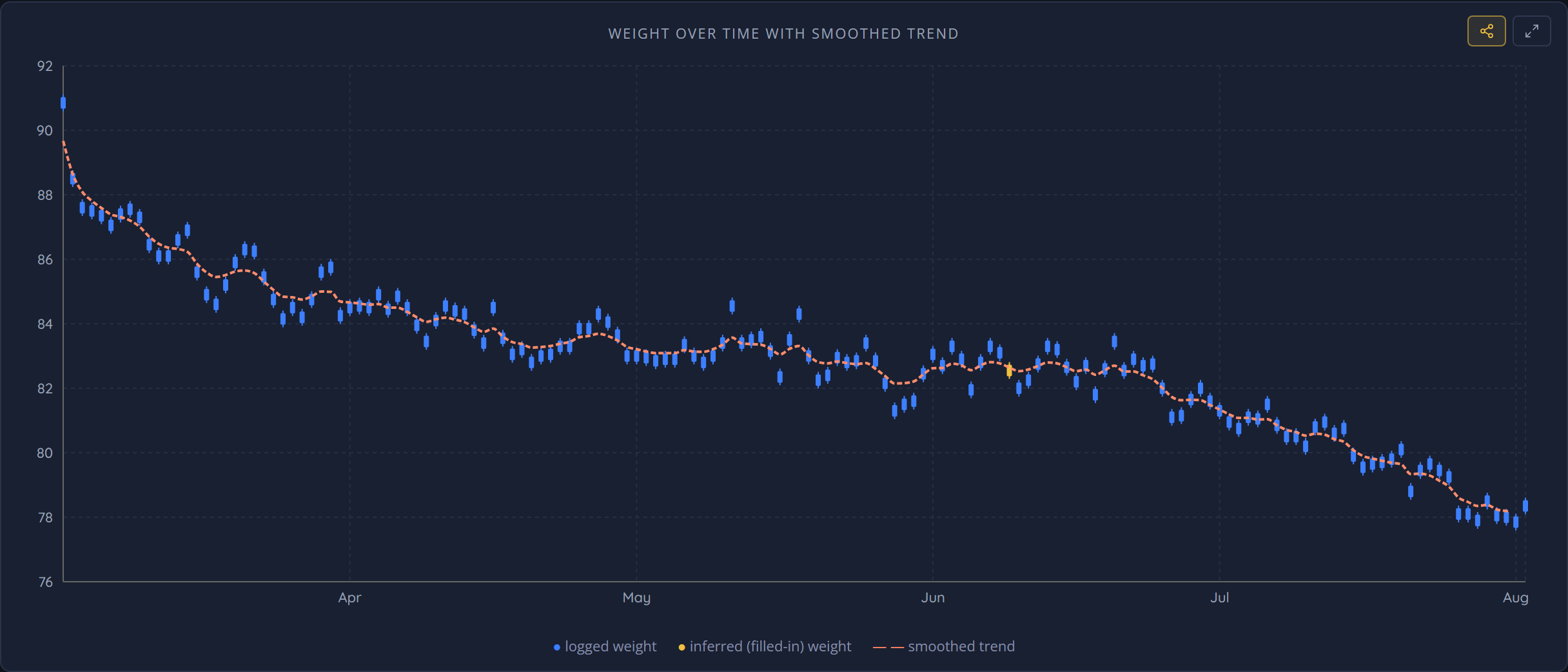
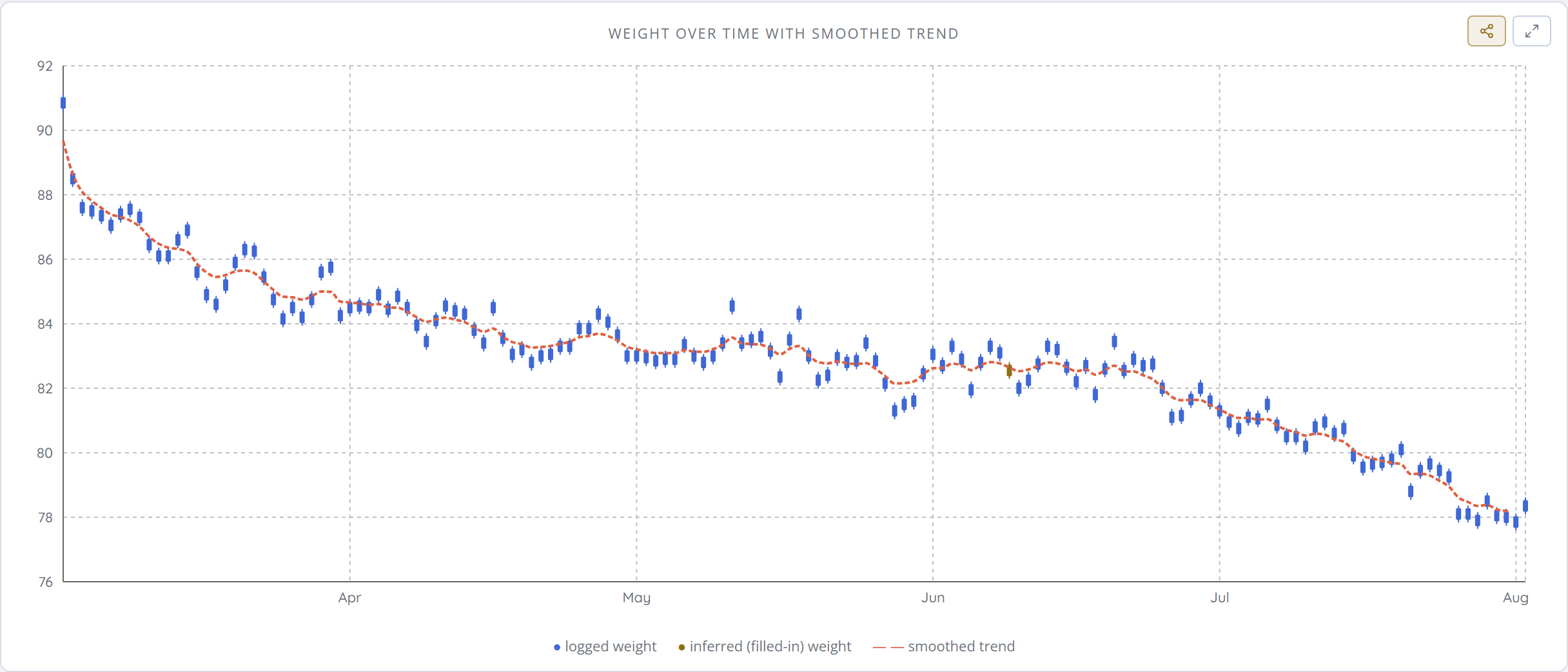
Whatever number you were dealt, this is the part you control — body fat coming off, week after week, in a line that ignores the daily noise.
The takeaway
- Your "abs" are one muscle, the rectus abdominis; the "packs" are segments fenced off by fibrous bands (tendinous intersections) and one central seam.
- Pack count = band count. Two visible bands read as a four-pack, three as a six, four as an eight — and the bands often sit asymmetrically. All normal.
- The count, spacing, and symmetry are genetic and fixed — set before birth, unreachable by any exercise.
- Training only ever does two things: reveals the muscle by stripping fat, and thickens it so it stands out more. A sharp four-pack beats a blurry six.
So if someone congratulates you on a six-pack and you've only got four — you're not behind. You're just accurately counting a muscle most people have never bothered to read.
Whatever number you were dealt, the one thing standing between you and seeing it is body fat — and that's a numbers game, not a mystery. Metabolistic measures your real burn from your own data and tracks the fat coming off, week by week, so "getting lean enough to see them" stops being guesswork.